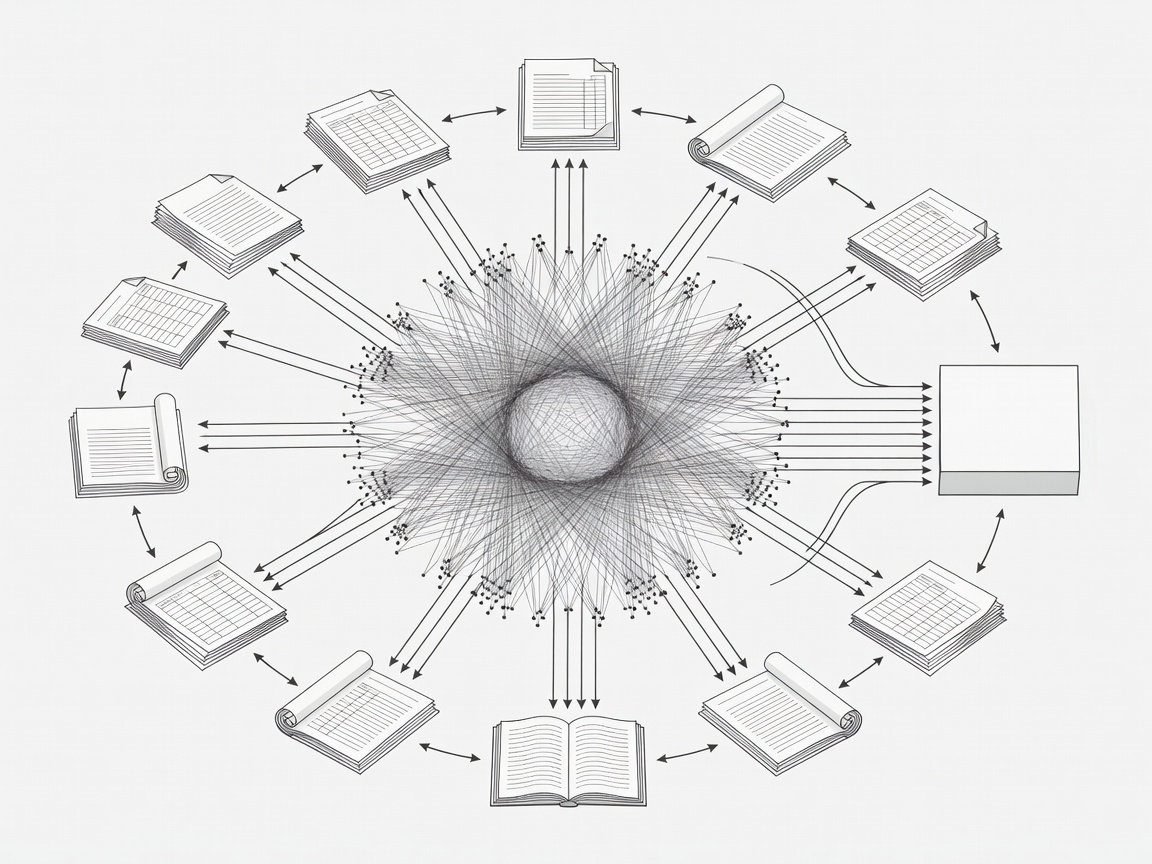
The Pitfalls of Fragmented Retrieval (RAG) in Dense Records
For several years, enterprise engineering teams relied almost exclusively on standard Retrieval-Augmented Generation (RAG) patterns to process extensive textual corpuses. Under this convention, documents are partitioned into short passages of 300 to 800 words, converted into mathematical vectors, and stored in vector databases. When an analyst queries the system, cosine similarity returns top-ranking fragments.
In complex corporate research, this methodology frequently exhibits systemic failure modes:
- Cross-Chapter Narrative Severance: When an executive compensation contingency outlined in note 18 modifies an accounting liability discussed on page 42, isolated vector lookups fail to link the conditions.
- Contextual Blindness in Tabular Footnotes: Numerical schedules in SEC Form 10-K filings lose semantic coherence when chopped horizontally across tables.
- Silent Hallucinations Under Incomplete Retrieval: When the retrieval step omits an essential caveat contained elsewhere in the dossier, the language model formulates assertive but factually incorrect assertions.
Architectural Mechanics of Claude 200k Context Windows
Modern frontier models, specifically Anthropic Claude 3.5 Sonnet and Opus series, operate with an operational context window of 200,000 tokens—roughly equivalent to 150,000 English words or 500 pages of single-spaced documentation. Rather than indexing dissociated snippets, the entire dossier is ingested into active model attention.
This enables "Needle in a Haystack" extraction rates surpassing 99%, allowing cross-referencing algorithms to evaluate structural shifts across an entire fiscal year or audit cycle simultaneously.
| Evaluation Metric | Standard Chunked RAG | Claude Monolithic Context (200k) |
|---|---|---|
| Cross-Document Discrepancy Detection | Limited (32–48% recall) | High (>96% verified recall) |
| Complex Tabular Preservation | Poor (often broken into tokens) | Excellent (raw Markdown/HTML tables) |
| Multi-Hop Reasoning Latency | Low (1.2–3.5 seconds) | Moderate (12.0–28.0 seconds) |
| Inference Compute Cost | Micro-scale ($0.001 - $0.005) | Enterprise tier ($0.60 - $3.00/query) |
Comparative Operational Assessment: Pros & Cons
Structural Strengths
- Total integrity of longitudinal narrative threads.
- Factual grounding with precise page and line citations.
- Direct comprehension of nested footnotes and fiscal disclosures.
- Zero database vector re-indexing overhead upon document updates.
Implementation Trade-Offs
- Elevated cost per full-context inference round.
- Noticeable latency for complete document ingestion passes.
- Requires disciplined prompt caching to control operational budgets.
Cost Optimization: Context Caching Protocols
To deploy monolithic document evaluation economically, enterprise architects utilize prompt caching mechanisms. When analyzing a static 180,000-token merger prospectus, the initial write phase incurs full processing charges, while subsequent queries reading from cache yield up to an 80% to 90% reduction in token pricing and substantial latency reductions.
Recommended Technical Implementation Blueprint
- Normalization Stage: Convert raw PDF and TIFF materials into standardized structured Markdown using high-fidelity OCR tools that preserve table hierarchies.
- Structural Tagging: Encase document sections inside explicit XML boundaries (`<filing_period_2025>`, `<auditor_opinion>`) to facilitate targeted attention allocation.
- Bi-Directional Citation Prompts: Mandate that every numerical finding or executive summary point return both the textual fragment quote and its hierarchical section tag.